


Have you ever wondered how babies around the world begin to make the same sounds but when they grow they speak completely distinct languages? Or how have you ever tried to copy someone's accent and found that it felt so natural, almost like slipping into their voice?
Well the secret is found in phonetics. It is the interesting science of how we form and perceive communication. By understanding the fundamentals of phonetics we can uncover the very foundation of language itself.
So, let's delve in and investigate how phonetics reveals the hidden patterns behind the way we all talk.
What is Phonetics?
Phonetics is the branch of linguistics that deals with the study of sounds used in human speech. Phonetics is often called “DNA OF SPEECH” because it represents the fundamental building blocks and instructions for all spoken language and all languages are built from sounds, and phonetics helps us understand how those sounds work.
Every language in the world, whether it is English, Tamil, French or Chinese is built from a finete set of sounds. These sounds may differ in tone, rhythm, or articulation, but phonetics gives us the tools to analyze them in a universal way.
This is why a linguist in any part of the world uses the same phonetic symbols from the International Phonetic Alphabet (IPA) to describe how a word is pronounced, even if they don’t share the same language.
To put in simple words, phonetics is all about how sounds are produced by our mouths (Articulatory Phonetics), how they travel through the air (Acoustic Phonetics), and how they're received by our ears (Auditory Phonetics).
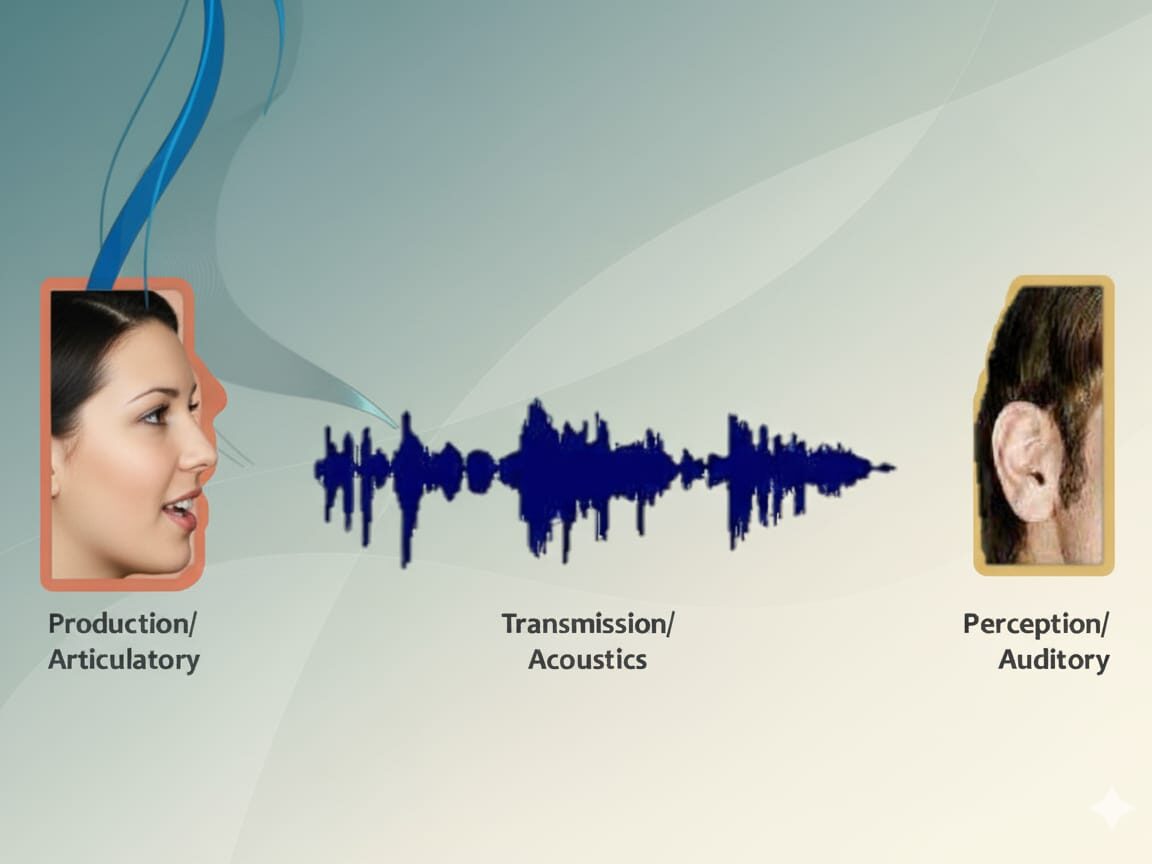
Let’s take a closer look at these three pillars of phonetics.
Articulatory Phonetics:
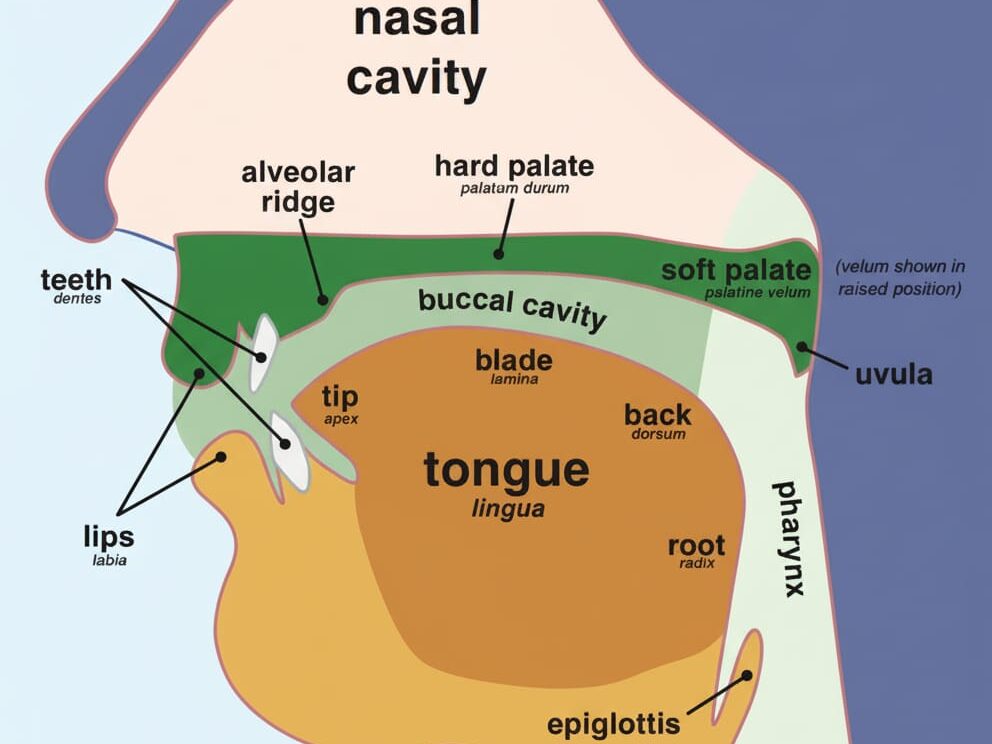
When we speak, our body works like a musical instrument. The lungs expel the air, the vocal cords vibrate, and our tongue, lips, and teeth shape the sounds. We refer to this process as articulatory phonetics. It focuses on the various speech sounds produced by the mouth and throat.
For example:
When you say “b,” your lips come together.
When you say “s,” air flows between your teeth.
Try saying “M”, you’ll feel the vibration in your nose, showing how nasal sounds are made.
Articulatory phonetics doesn’t just stop at explaining which parts of the mouth move during speech but also gives us a structured way to classify sounds based on how they are made and where the airflow is shaped.
Articulatory phonetics classifies sounds into many categories. Let’s break down some of the major groups.
Consonants
Consonants are sounds created when the airflow from the lungs is either fully blocked for a moment or partially restricted as it passes through the mouth. This interruption is what makes consonants different from vowels, which flow more freely.
The type of consonant we produce depends on two main factors:
Place of articulation – where in the vocal tract the airflow is blocked or narrowed.
For example:
- Bilabial: sounds made with both lips (like /p/ and /b/).
- Dental: sounds made with the tongue against the teeth (like /θ/ in think).
- Velar: sounds made at the back of the mouth with the soft palate (like /k/ and /g/).
Manner of articulation – how the airflow is restricted.
For example:
- Stops: the air is completely blocked and then released (as in /t/ or /p/).
- Fricatives: the air is forced through a narrow passage, creating friction (as in /s/ or /f/).
- Affricates: a stop followed by a fricative (like /ch/ in chair).
- Nasals: airflow is directed through the nose (like /m/ or /n/).
- Glides & Liquids: smoother, flowing consonants like /w/, /l/, and /r/.
Consonants are the structure and shape of words; they are the architecture of speech. Without consonants our sentences would sound like a string of open vowels, almost like humming.
For example
Imagine the word mat without its consonants, it would just be “aa.”
Vowels
Vowels are different from consonants because the mouth stays more open and the air flows freely. The sound mainly changes based on how the tongue and mouth are shaped.
For example:
- /a/ as in a cat is made with the mouth open and tongue low.
- /i/ as in sit has the tongue raised towards the front of the mouth.
- /u/ as in food involves rounding the lips and raising the back of the tongue.
Vowels are also described by features like height (high vs. low tongue position), backness (front vs. back of the mouth), and lip rounding. These subtle adjustments are why English “beat” /i/ and “bit” /ɪ/ sound so similar, yet clearly different.
Nasals
Nasals are produced by lowering the soft palate (the velum), allowing air to flow out through the nose instead of the mouth. This is why, when you hum with your mouth closed, you still make a sound.
Common examples include:
- /m/ as in man – made with both lips closed while air flows through the nose.
- /n/ as in net – the tongue blocks airflow at the front, sending air through the nose.
- /ŋ/ as in sing – the back of the tongue presses against the soft palate.
Nasals give speech a rich, resonant quality, and are common across nearly all languages.
Well each of these categories shows just how versatile the human vocal system is. By combining different articulatory actions, we produce the immense variety of sounds that make up the world’s languages.
In short, articulatory phonetics shows us how speech sounds are made. From the quick burst of a consonant to the smooth flow of a vowel or nasal, every sound follows a pattern, and phonetics gives us the words to explain it.
Acoustic phonetics:
The study of the physical characteristics of speech sounds is known as acoustic phonetics. A sound travels through the atmosphere as sound waves after it is created. Features like frequency (pitch), amplitude (loudness), and duration (length of the sound) can be used to analyze these waves.
Acoustic phoneticians measure the pitch, loudness, and duration of sounds using instruments like spectrograms and waveforms.
Another interesting part of acoustic phonetics is that it shows details our ears might not easily catch. For example, spectrograms create visual “maps” of sounds, helping us see small differences between words like “bat” and “pat.” Even though they sound almost the same, the timing and frequency make them different.
Acoustic phonetics is also important in music and performance. Singers, actors, and speech trainers use pitch, rhythm, and resonance to sound clear and expressive. With the help of sound analysis, vocal coaches can guide performers to adjust their tone and volume for different situations.
In healthcare, sound analysis is used to diagnose and treat speech and hearing problems. For instance, changes in voice quality can reveal issues like vocal cord damage, stuttering, or even early signs of diseases such as Parkinson’s.
So, Acoustic phonetics helps us understand the science of sound more clearly. It shows that speech is not just about talking, but about patterns that our ears and brains process. By studying these patterns, we can improve technology, healthcare, and also learn more about the beauty and variety of human languages.
Auditory Phonetics:
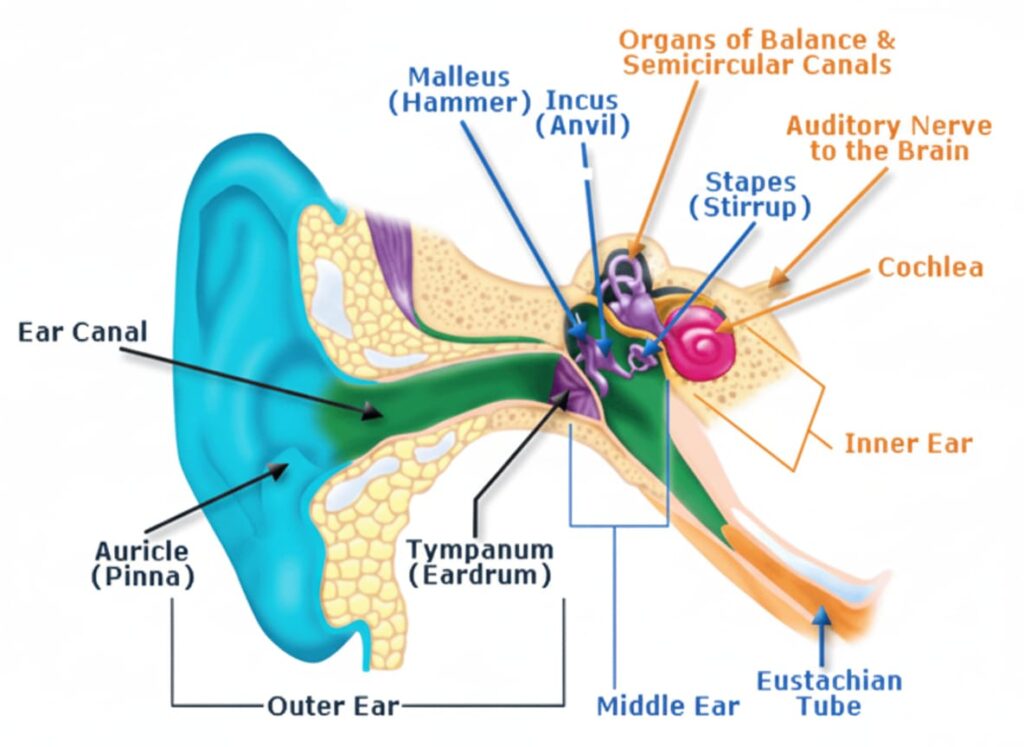
The study of auditory phonetics focuses on how humans perceive and interpret sound. It looks at how the ear receives sound waves and how the brain converts them into linguistically meaningful information.
It primarily describes how we distinguish between similar sounds, such as "ship" and "sheep." This shows how finely tuned our hearing is when it comes to language.
Auditory phonetics is also useful in real life. It helps in developing better hearing aids and cochlear implants for people with hearing loss. It is also used in speech therapy, where understanding how patients hear sounds can improve their ability to speak more clearly.
It also plays an important role in everyday communication. It explains why we can still understand someone even if they speak quickly, whisper, or have a different accent. Our brain uses context and sound patterns to “fill in the gaps,” making speech easier to follow.
It also helps us understand why miscommunication happens. Sometimes, background noise or unclear pronunciation can make words sound alike, and our ears may confuse them. Studying auditory phonetics shows us how the brain works to solve these problems and why listening is an active skill, not just a passive one.
Another interesting part of auditory phonetics is how it connects to emotions. The way we hear pitch, loudness, and tone of voice can change the meaning of a message. For example, the same sentence can sound friendly, angry, or sarcastic depending on how it is spoken. This shows that listening is not only about words but also about feelings carried in the sound.
So with the help of these three foundations, phonetics provide us with a comprehensive understanding of human speech, from the moment a sound is made to the moment it is understood.
Phonics vs Phonetics?
We already know what phonetics is, so now let’s look at phonics and see how it differs.
Have you ever wondered how the letter on the page turns into words we can say and understand? That's where phonics comes in. Phonics is all about learning to read by connecting sounds to letters. It's a method that helps new readers, especially kids, figure out words by understanding that spoken sounds have matching letters on the page.
For example, phonics teaches us the letter 'm' makes a /m/ sound, the letter 'a' makes an /a/ sound, and the letter 't' makes a /t/ sound. When you put them together, you get the word "\mat." Phonics shows us how to blend and segment sounds to form complete words, making it a key step in learning to read and spell. Now, let’s look at how phonics differs from phonetics.
Phonics vs Phonetics
| Aspect | Phonics | Phonetics |
| Definition | A method of teaching reading and writing. | The science of speech sounds. |
| Focus | Shows how letters or groups of letters are connected to sounds. | Studies how sounds are made, how they sound, and how we hear them. |
| Goal | To help children read and spell words. | To describe and understand all the sounds of human language. |
| Examples | - c → /k/ in cat - sh → /ʃ/ in ship - th → /θ/ in thin | - cat = /kæt/ - /t/ is a voiceless alveolar stop |
| Used in | Schools, literacy teaching, children’s books. | Linguistics, speech therapy, accent training, language learning. |
Phonolog vs Phonetics?
We already know what phonetics is, so now let’s look at phonology and see how it differs.
Phonology is the study of how sounds are used in a language. While phonetics looks at the physical sounds we produce, phonology looks at how sounds work in our minds and in communication. It explains which sounds matter for meaning and how they are arranged in a language.
Phonology also studies how sounds change depending on where they appear in a word and the rules that control their use. For example, in English, the sounds /p/ in pat and /b/ in bat make different meanings, so they are treated as separate sounds.
Now, let’s look at how phonology differs from phonetics.
Phonology vs Phonetics
| Aspect | Phonology | Phonetics |
| What it is | The study of how sounds are organized and function in a language. | The study of the physical properties of speech sounds. |
| Focus | How sounds create meaning, patterns, and rules in a specific language. | How sounds are produced, transmitted, and perceived. |
| Scope | Language-specific: studies sound systems of individual languages. | Universal: studies all possible human speech sounds. |
| Key Question | “Does this sound make a difference in meaning in this language?” | “What does this sound physically look, feel, or sound like?” |
| Example (English) | /p/ vs. /b/ → pat vs. bat (changes meaning, so different phonemes). | pin [pʰ] vs. spin [p] (one has aspiration, but both mean the same word). |
| Applications | Linguistics, grammar, accent study, language learning. | Linguistics, speech therapy, language teaching, speech science. |
Why Phonetics is Important?
We all learned our ABCs, and perhaps even some basic grammar rules, but there's a whole world of sound that often goes unnoticed, guess what ? You are right, it is the fascinating realm of phonetics.
From ordering coffee to learning how children speak, phonetics is everywhere and most of the time we fail to recognize it. Lets see a few important areas of where phonetics plays a greater role in human life.
Clear Communication:
Phonetics plays a vital role in clear communication because it teaches us how to make and understand speech sounds and it helps us avoid misunderstandings in everyday conversations.
Take for example, words like "desk" and "disk." They may sound similar, but a trained ear knows they are phonetically different. Understanding this subtle difference makes our speech more precise and easier to follow.
Today in this globalized world we constantly communicate with people from different regions and with different accents, phonetics provides a universal framework for understanding how sounds are produced. This means we can appreciate and comprehend a wide range of voices and accents, breaking down barriers and fostering better connections.
Language Learning
Phonetics is a powerful tool when it comes to learning a new language. Without Phonetics learners often struggle with pronunciation, listening comprehension, and overall communication. Learning a new language is more than memorizing vocabulary and grammar but it is mastering the sounds that brings those sounds to life.
A new learner of English language may find it difficult to hear and pronounce the difference between words like “ship” and “sheep” for they sound almost the same but Phonetics helps learners recognize these subtle sound contrasts and train their ears to tell them apart.
In short, phonetics is like a roadmap for anyone who learns a new language because it makes them sound like a native speaker.
Speech Therapy
Phonetics is a lifesaver for people with speech difficulties because It provides the tools and techniques to diagnose and correct mispronunciations, giving individuals the chance to communicate clearly and confidently thus saving them from addressing issues that can seriously affect their social lives, careers, and finances.
Not only from speech difficulties, people who are recovering from strokes, brain injuries often work with speech therapists who rely on phonetics to rebuild or improve speech patterns.
In fact professionals like actors, public speakers use phonetic techniques to refine their voice, diction, and clarity because a clear voice allows them to express themselves fully with confidence.
Technology
Have you ever wondered how Alexa can play the exact song you asked for? It feels like magic, doesn't it? To have a technology that understands your spoken words so quickly is nothing short of incredible.
Well, the secret behind this magic is phonetics. It paved the way for the foundation of speech recognition systems which teaches the machines to recognize and process the sounds of human language.
Every time you speak, your words are instantly broken down into tiny sound units then the sounds are matched with the phonetic patterns that are stored in the system's data base This lightning fast process allows the system to figure out exactly what you meant, turning your voice into a command.
The Complete Guide to the International Phonetic Alphabet (IPA)
The International Phonetic Alphabet (IPA) is a system of symbols representing the exact sounds of spoken language. Developed in the late 19th century by the International Phonetic Association, it solves the problem of inconsistent spelling by following a simple rule: one sound = one symbol. This makes it an essential tool for learners, teachers, linguists, and even speech therapists. For example, blog is /blɒɡ/ in British English but /blɑːɡ/ in American English—IPA shows the difference clearly.
Why IPA is Useful
- Clarity: Each sound has one symbol, e.g. cat /kæt/, car /kɑːr/, call /kɔːl/.
- Universal: It applies to all languages, from English to Hindi or French.
- Language Learning: Dictionaries include IPA to guide pronunciation.
- Linguistics & Therapy: Used for speech disorders, dialect study, and endangered language documentation.
- Beyond Linguistics: Important in singing, acting, and voice technology.
IPA Symbol Categories
Consonants (airflow blocked or restricted)
- Plosives: /p b t d k ɡ/
- Nasals: /m n ŋ/
- Fricatives: /f v θ ð s z ʃ ʒ h/
- Affricates: /tʃ dʒ/
- Approximants: /l r j w/
Vowels (open airflow, shaped by tongue/lips)
- Front: /iː ɪ e æ/
- Central: /ʌ ɜː ə/
- Back: /uː ʊ ɔː ɒ ɑː/
- Diphthongs: /aɪ eɪ ɔɪ aʊ əʊ ɪə eə ʊə/
Suprasegmentals (extra features)
- Stress: ˈabout
- Length: /iː/ see
- Intonation: [ˈhelloː↓], [ˈhelloː↑]
- Tone (Mandarin): [má˧˥], [mà˨˩]
Diacritics (modifiers)
[pʰ] aspiration (pin), [ã] nasalization (sans), [n̩] syllabic (button), [ɚ] rhoticity (teacher).